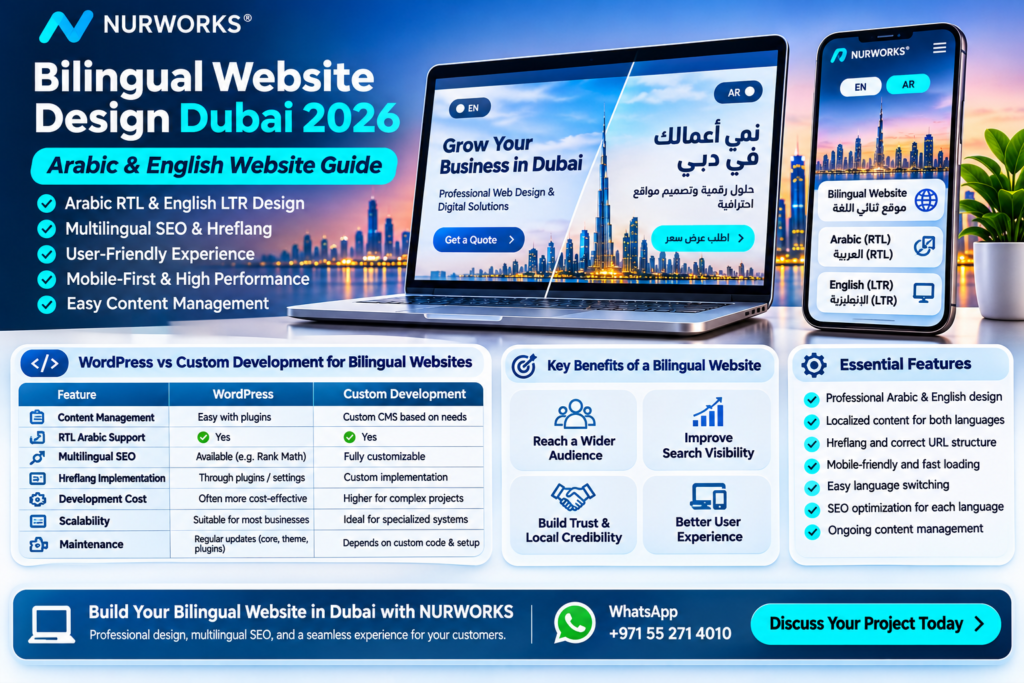
Bilingual Website Design Dubai: Arabic & English Website Guide
Investing in bilingual website design in Dubai can help businesses communicate effectively with Arabic-speaking and English-speaking customers. A well-designed multilingual website should do more than translate text. It should deliver a consistent user experience, clear navigation, accessible content, and search-friendly pages in both languages.
Dubai is home to businesses serving diverse audiences, making language accessibility an important consideration for corporate websites, ecommerce stores, professional services, and customer-facing platforms.
In this guide, NURWORKS explains the essential features of Arabic and English websites, common development challenges, multilingual SEO requirements, and how to choose the right approach for your business.
Why Bilingual Website Design Matters in Dubai
A bilingual website allows visitors to access important information in their preferred language.
Potential benefits include:
- Clearer communication with different customer groups.
- Improved accessibility to products and services.
- More useful localized content.
- Better navigation for Arabic and English users.
- Opportunities to target relevant search queries in both languages.
- A consistent brand experience across language versions.
However, simply adding a language switcher does not guarantee better search visibility or more conversions. Each language version needs useful content and proper technical implementation.
7 Essential Features of Bilingual Website Design Dubai Businesses Need
1. Professional Arabic RTL and English LTR Layouts
Arabic is read from right to left (RTL), while English is read from left to right (LTR).
A professional bilingual website should adapt its layout to each language rather than merely translating the words.
Important considerations include:
- Navigation direction.
- Text alignment.
- Icons and directional controls.
- Forms and input fields.
- Breadcrumb navigation.
- Tables and cards.
- Mobile layouts.
- Appropriate Arabic typography.
The design should remain consistent with the brand while respecting each language’s reading direction.
2. Accurate Arabic and English Content
Translation quality influences how clearly customers understand your services.
Effective bilingual content should consider terminology, tone, local expectations, and search intent.
For example, a literal translation of an English keyword may not match the phrase Arabic-speaking customers actually search for.
Businesses should review translated content for clarity and accuracy rather than relying entirely on automated translation.
3. Multilingual SEO and Keyword Research
Search engine optimization should be planned separately for Arabic and English pages.
A bilingual SEO strategy may include:
- Arabic keyword research.
- English keyword research.
- Language-specific SEO titles.
- Localized meta descriptions.
- Relevant headings.
- Internal links within each language.
- Unique and useful page content.
- Search Console performance monitoring.
For example, an English page targeting “Web Design Dubai” may have an Arabic counterpart targeting “تصميم مواقع إلكترونية في دبي”.
Both pages should serve their respective audiences without creating unnecessary duplicate pages.
4. Correct Hreflang Implementation
Hreflang annotations help search engines understand relationships between language and regional versions of pages.
A bilingual website may use annotations such as:
en-AEfor English content targeting the UAE.ar-AEfor Arabic content targeting the UAE.
The correct configuration depends on the website’s actual language and regional targeting.
Important checks include:
- Matching language versions.
- Reciprocal annotations.
- Valid destination URLs.
- Appropriate canonical URLs.
- Consistent language switching.
Google provides detailed documentation on localized versions of pages.
5. Easy Language Switching
Visitors should be able to switch between Arabic and English without losing their place.
A useful language switcher should:
- Be easy to find.
- Use clear language labels.
- Link to the corresponding translated page when available.
- Avoid unnecessary redirects.
- Work correctly on mobile devices.
- Handle pages without translations appropriately.
Automatically forcing users into a language based solely on browser settings can create usability problems.
6. Mobile-Friendly Bilingual Website Design
Many visitors access business websites using mobile devices.
Both language versions should support:
- Responsive layouts.
- Readable typography.
- Accessible menus.
- Touch-friendly buttons.
- Optimized images.
- Stable page layouts.
- Clear contact options.
- Usable forms.
Arabic text may require different spacing and layout adjustments from English text.
7. Easy Content Management
Businesses should be able to update both language versions without complicated workflows.
Content management requirements may include:
- Editing service pages.
- Publishing bilingual articles.
- Updating contact information.
- Managing images.
- Adding translated products.
- Updating SEO metadata.
- Reviewing missing translations.
A suitable CMS can make ongoing multilingual website maintenance more manageable.
WordPress vs Custom Development for Bilingual Websites
Both WordPress and custom development can support Arabic and English websites.
| Feature | WordPress | Custom Development |
|---|---|---|
| Content management | Built-in administration | Depends on CMS architecture |
| Translation workflow | Available through multilingual tools | Requires planned implementation |
| RTL support | Supported with suitable themes and styling | Must be implemented in the interface |
| SEO metadata | Managed through plugins and configuration | Requires appropriate implementation |
| Hreflang | Can be managed through multilingual configuration | Requires technical implementation |
| Maintenance | Core, theme and plugin updates | Custom code and dependency maintenance |
| Flexibility | Suitable for many business websites | Useful for specialized requirements |
WordPress may be practical for companies that regularly publish service pages and articles.
Custom development may be appropriate for complex applications or specialized business workflows.
Neither approach automatically guarantees better multilingual SEO.
Bilingual Ecommerce Website Development in Dubai
Online stores may require additional multilingual features.
These include:
- Translated product titles and descriptions.
- Arabic and English category pages.
- Language-aware search.
- Consistent product variations.
- Translated checkout labels.
- Order notification translations.
- Payment and shipping compatibility.
- Product structured data.
- Appropriate product URL handling.
The exact requirements depend on the ecommerce platform and catalog size.
Common Multilingual Website SEO Mistakes
Businesses should avoid:
- Using the same SEO title for both languages.
- Translating keywords without researching search behavior.
- Missing hreflang relationships.
- Linking the language switcher to unrelated pages.
- Incorrect canonical tags.
- Publishing incomplete translated pages.
- Creating unnecessary duplicate location pages.
- Using English-only navigation on Arabic pages.
- Ignoring mobile RTL layout problems.
A technical audit can help identify these issues before or after launch.
How Much Does Bilingual Website Design Cost in Dubai?
The cost depends on the project’s scope.
Important pricing factors include:
- Number of pages.
- Translation requirements.
- Design complexity.
- CMS or development platform.
- Ecommerce functionality.
- Language-specific SEO setup.
- Third-party integrations.
- Content migration.
- Testing and maintenance.
A small bilingual company website generally has different requirements from a multilingual ecommerce platform.
Request a quotation that clearly separates design, development, translation, SEO setup, and ongoing support.
How to Choose a Bilingual Website Design Company in Dubai
Before hiring a provider, ask:
- Will Arabic layouts be designed and tested separately?
- Is the translation workflow included?
- Can we manage both languages ourselves?
- Will every translated page have its own SEO metadata?
- How will hreflang and canonical URLs be configured?
- Is mobile testing included for both languages?
- What happens when a page is available in only one language?
- Are translated forms and notifications included?
- How will existing URLs be preserved during redesign?
- What maintenance and training will be provided?
Clear answers help you compare proposals based on quality and scope.
Frequently Asked Questions
1. Why do businesses in Dubai need bilingual websites?
A bilingual website can make business information accessible to Arabic-speaking and English-speaking customers and support localized content strategies.
2. Is bilingual website design good for SEO?
It can support visibility for relevant searches in both languages when each version has useful content and correct technical configuration.
3. Does Google consider Arabic and English pages duplicate content?
Properly localized pages in different languages are generally not treated as simple duplicates merely because they cover the same topic. Correct language annotations and page structure remain important.
4. Can WordPress support Arabic and English websites?
Yes. WordPress can support bilingual websites using suitable multilingual tools, themes, and configurations.
5. What is RTL website design?
RTL design adapts layouts and reading direction for right-to-left languages such as Arabic.
6. Is hreflang necessary for bilingual websites?
Hreflang is recommended for helping Google identify alternate language or regional versions, but its implementation must be accurate.
7. Can I add Arabic to an existing English website?
Yes. The process may involve adding translated pages, adjusting layouts, configuring language URLs, and updating SEO settings.
8. How long does it take to build a bilingual website?
The timeline depends on the number of pages, translation readiness, design complexity, integrations, and testing requirements.
Build a Professional Arabic and English Website with NURWORKS
A successful bilingual website design Dubai project should combine professional design, useful localized content, reliable technical implementation, and an easy content management experience.
NURWORKS helps businesses plan Arabic and English websites that support clear communication, usability, and search-friendly architecture.
Whether you need a corporate website, ecommerce store, or multilingual service platform, you can discuss your requirements and explore an appropriate development approach.
Discuss your bilingual website project with NURWORKS.
WhatsApp: +971 55 271 4010
Website: https://nurworks.site/